Duaction: How It Combines Learning, Technology, and Productivity
Duaction has recently become a topic of interest across blogs, technology websites, and online discussions. As more people search for the term, they often encounter conflicting explanations. Some sources describe it as a learning approach, others present it as an AI-assisted workflow for web development, while a few associate it with productivity and personal growth. This variety of interpretations can leave readers wondering what it actually means.
The reason for this confusion is simple: it is an emerging concept rather than a universally recognized framework. Unlike established methodologies backed by academic research or industry standards, it is still evolving. Different writers and industries have adopted the term to describe similar ideas from different perspectives.
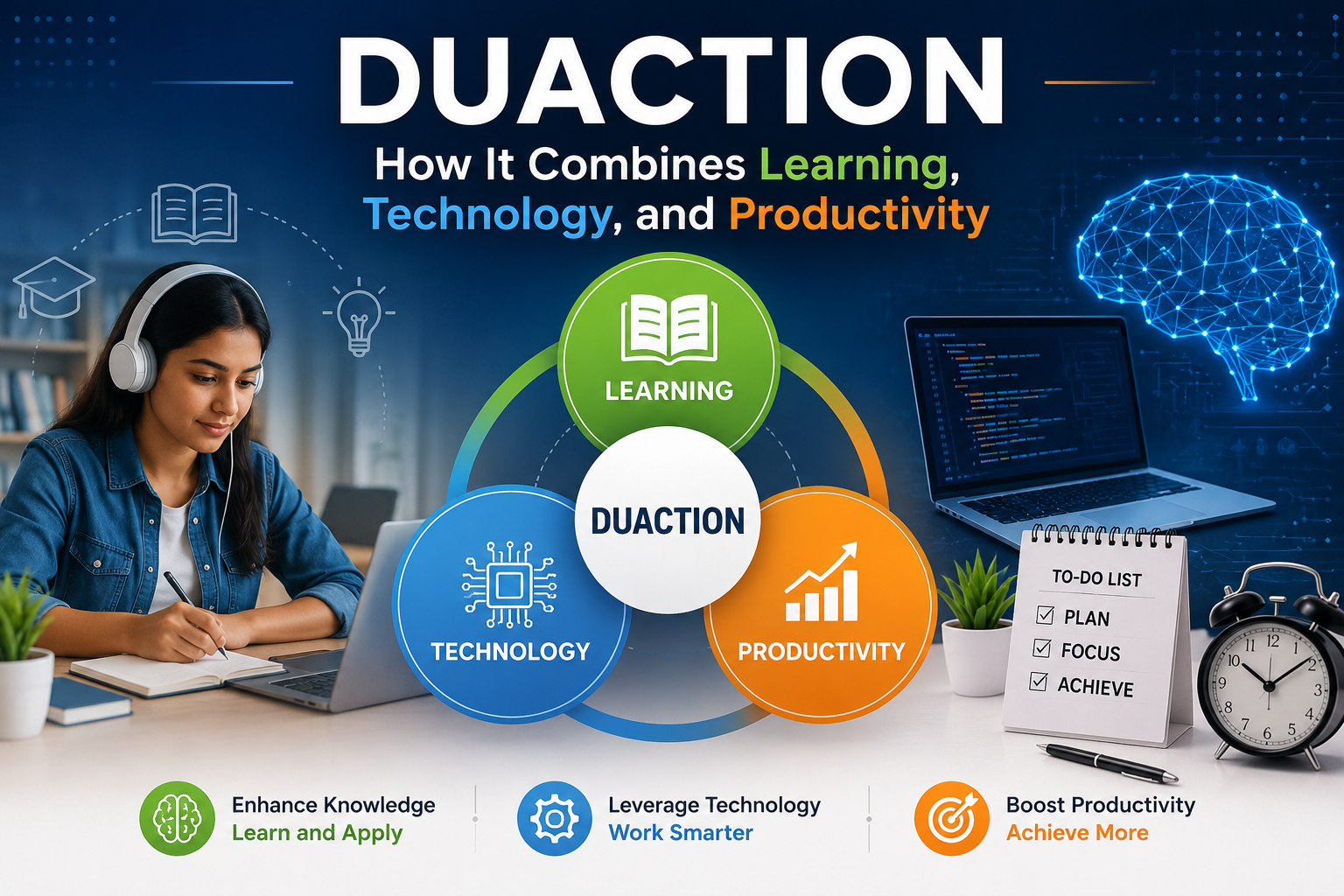
Despite these differences, a common principle connects most definitions. Duaction generally refers to combining two complementary actions or processes to achieve better outcomes than either approach could deliver on its own. Whether those actions involve learning and practice, human expertise and artificial intelligence, or planning and execution, the emphasis remains on integration rather than separation.
What Is Duaction?
It is commonly interpreted as a combination of the words “Dual” and “Action.” The concept focuses on bringing together two complementary activities that work toward a shared objective.
Rather than relying on a single method, Duaction encourages combining planning with execution, knowledge with practical application, or human decision-making with technological assistance. Although the exact definition varies depending on the context, the central idea remains consistent: better results often come from integrating multiple strengths instead of depending on only one approach.
Since there is no official governing body or academic institution defining it, different industries have adapted the concept according to their own needs. This explains why education websites, technology blogs, and productivity articles describe it differently while sharing similar underlying principles.
The Origin and Evolution of Duaction
Unlike many established business or educational methodologies, it does not have a clearly documented origin. The term has primarily appeared on digital publications and blogs rather than in academic journals or formal industry documentation.
As online discussions expanded, writers began applying the concept to different fields.
In education, Duaction became associated with combining classroom learning and practical experience.
In technology, it evolved into describing collaboration between developers and AI-powered tools.
Within productivity discussions, it came to represent balancing planning with meaningful execution.
Although these interpretations differ, they all emphasize combining complementary processes instead of treating them separately.
The Core Principles Behind Duaction
Several recurring principles appear across the different interpretations of it.
Combining Complementary Actions
The primary idea is that two connected activities often produce stronger results than either activity alone.
Examples include:
- Learning while practicing
- Planning while executing
- Human expertise supported by AI
- Analysis followed by implementation
Instead of separating these stages, Duaction encourages integrating them into a continuous workflow.
Continuous Improvement
Another important principle is ongoing refinement.
Rather than viewing work as a one-time process, it encourages reviewing results, identifying improvements, and applying lessons learned during future tasks. This iterative cycle supports gradual progress instead of expecting perfection from the beginning.
Adaptability of Duaction
Modern workplaces and learning environments change rapidly.
It emphasizes flexibility by encouraging individuals and organizations to adjust strategies based on feedback, new information, and changing circumstances.
How Duaction Works
Although applications vary, most workflows follow a similar process.
Step 1: Define the Objective
Every project begins by identifying a clear goal. Whether the objective involves learning a new skill, developing software, or improving productivity, understanding the desired outcome provides direction.
Step 2: Combine Complementary Methods
The next step involves selecting approaches that support one another.
For example:
- Theory with practice
- Human creativity with AI assistance
- Strategic planning with execution
The purpose is to maximize strengths while minimizing weaknesses.
Step 3: Take Action on Duaction
Ideas only become valuable when implemented.
It encourages immediate application instead of delaying execution until every detail feels perfect.
Step 4: Evaluate Results
Once actions have been completed, performance should be reviewed carefully.
This includes identifying successes, challenges, and opportunities for improvement.
Step 5: Improve and Repeat
The final step focuses on refining the process based on experience.
Instead of treating mistakes as failures, Duaction views them as opportunities for continuous learning.
Where Duaction Can Be Applied
One reason the concept has gained attention is its flexibility across multiple industries.
Education
Educational institutions increasingly encourage students to apply knowledge through projects, practical exercises, internships, and collaborative assignments.
Instead of memorizing information for examinations, learners actively demonstrate their understanding through real-world application.
Artificial Intelligence and Technology
AI has transformed how professionals complete many technical tasks.
Developers, designers, marketers, and analysts frequently combine human expertise with AI-powered assistance to improve efficiency while maintaining creative control.
In this context, Duaction represents collaboration rather than replacement.
Software and Web Development
Some online sources specifically describe it as an AI-assisted development approach.
Although there is no officially recognized software platform using this definition, the underlying principle reflects current development trends.
Developers increasingly rely on AI tools to:
- Generate code suggestions
- Identify programming errors
- Improve documentation
- Automate repetitive tasks
- Speed up testing
Human judgment remains essential while AI handles repetitive processes.
Business and Project Management by Duaction
Organizations often combine strategic planning with rapid execution.
Project teams continuously gather feedback, improve workflows, and adjust priorities rather than following rigid plans that never change.
This practical balance aligns closely with its underlying philosophy.
Personal Productivity
Individuals can also apply it in everyday life.
Examples include:
- Learning while practicing new skills
- Planning daily goals before completing tasks
- Reviewing completed work to improve future performance
- Combining physical activity with educational content, such as podcasts or language lessons
Key Characteristics of a Duaction-Based Approach
Several characteristics appear consistently regardless of the industry.
- Action-oriented thinking
- Continuous feedback
- Practical implementation
- Collaboration between people and technology
- Adaptability
- Problem-solving
- Long-term improvement
- Ongoing learning
Rather than emphasizing perfection, Duaction values steady progress through repeated improvement.
Benefits of Duaction
Although research specific to it remains limited, the principles associated with the concept offer several practical advantages.
Better Knowledge Retention
People generally remember information more effectively when they apply what they learn instead of only reading or listening.
Faster Skill Development
Practical experience often accelerates learning because individuals gain immediate exposure to real challenges.
Improved Decision-Making
Combining planning with execution helps people make informed decisions while remaining flexible enough to adapt when circumstances change.
Greater Productivity of Duaction
Integrating complementary methods reduces unnecessary delays and improves workflow efficiency.
Enhanced Collaboration
Duaction encourages individuals, teams, and technology to work together rather than independently.
Increased Adaptability
Modern industries evolve rapidly.
Continuous learning and improvement help individuals respond more effectively to changing requirements.
Duaction vs Traditional Approaches
| Feature | Traditional Approach | Duaction-Based Approach |
| Learning | Theory-focused | Theory combined with practice |
| Execution | Often delayed | Immediate application |
| Feedback | Periodic | Continuous improvement |
| Technology | Supporting role | Integrated into workflows |
| Flexibility | Structured process | Adaptive process |
| Collaboration | Often role-specific | Cross-functional teamwork |
| Improvement | Scheduled reviews | Ongoing refinement |
Rather than replacing traditional methods, it complements them by encouraging greater interaction between planning and action.
Common Misconceptions About Duaction
As interest in the topic grows, several misconceptions have appeared online.
Official Framework
At present, no evidence suggests that Duaction is an officially standardized educational, scientific, or business framework.
About Education
Although learning is one interpretation, many writers also apply the concept to technology, productivity, and business processes.
Duaction Is an AI Product
Some articles describe Duaction as an AI development tool, but no widely recognized software platform officially defines itself this way.
Universal Definition
This is perhaps the biggest misconception.
Current online discussions demonstrate that the term is still evolving, with multiple interpretations sharing similar principles.
Challenges and Limitations
Like any emerging concept, it also has limitations.
The most significant challenge is the absence of a standardized definition. Different websites explain the term differently, making it difficult for readers to identify a single authoritative meaning.
Organizations implementing approaches should also avoid assuming that technology alone guarantees better results. Human expertise, critical thinking, and practical experience remain essential.
Finally, because the concept continues to evolve, future interpretations may differ from those currently discussed online.
Why Duaction Is Becoming Popular
Several trends explain the growing interest in it.
Artificial intelligence has encouraged closer collaboration between humans and intelligent software.
Employers increasingly value practical skills alongside theoretical knowledge.
Businesses seek more adaptable workflows that respond quickly to changing markets.
Educational institutions continue shifting toward experiential and project-based learning.
Together, these developments have created an environment where integrated approaches naturally receive greater attention.
The Future Vision
Although Duaction is still an emerging concept, its underlying principles align with many long-term trends.
Future workplaces will likely rely more heavily on collaboration between people and AI.
Education will continue emphasizing practical learning experiences alongside traditional instruction.
Businesses will increasingly adopt continuous improvement models instead of rigid linear processes.
Whether or not the term “Duaction” becomes widely standardized, the philosophy of combining complementary actions to improve outcomes is likely to remain relevant across industries.
Final Thoughts
It represents an evolving concept rather than a universally accepted methodology. While different sources describe it in different ways, they generally share one important idea: combining complementary actions yields stronger results than relying on a single approach.
Whether applied to education, software development, business management, artificial intelligence, or personal productivity, Duaction encourages balancing planning with execution, knowledge with application, and human expertise with technological support.
As the concept continues to mature, clearer definitions may emerge. Until then, the most practical way to understand it is as a flexible framework for integrating complementary strengths, adapting to change, and pursuing continuous improvement in both professional and personal environments.