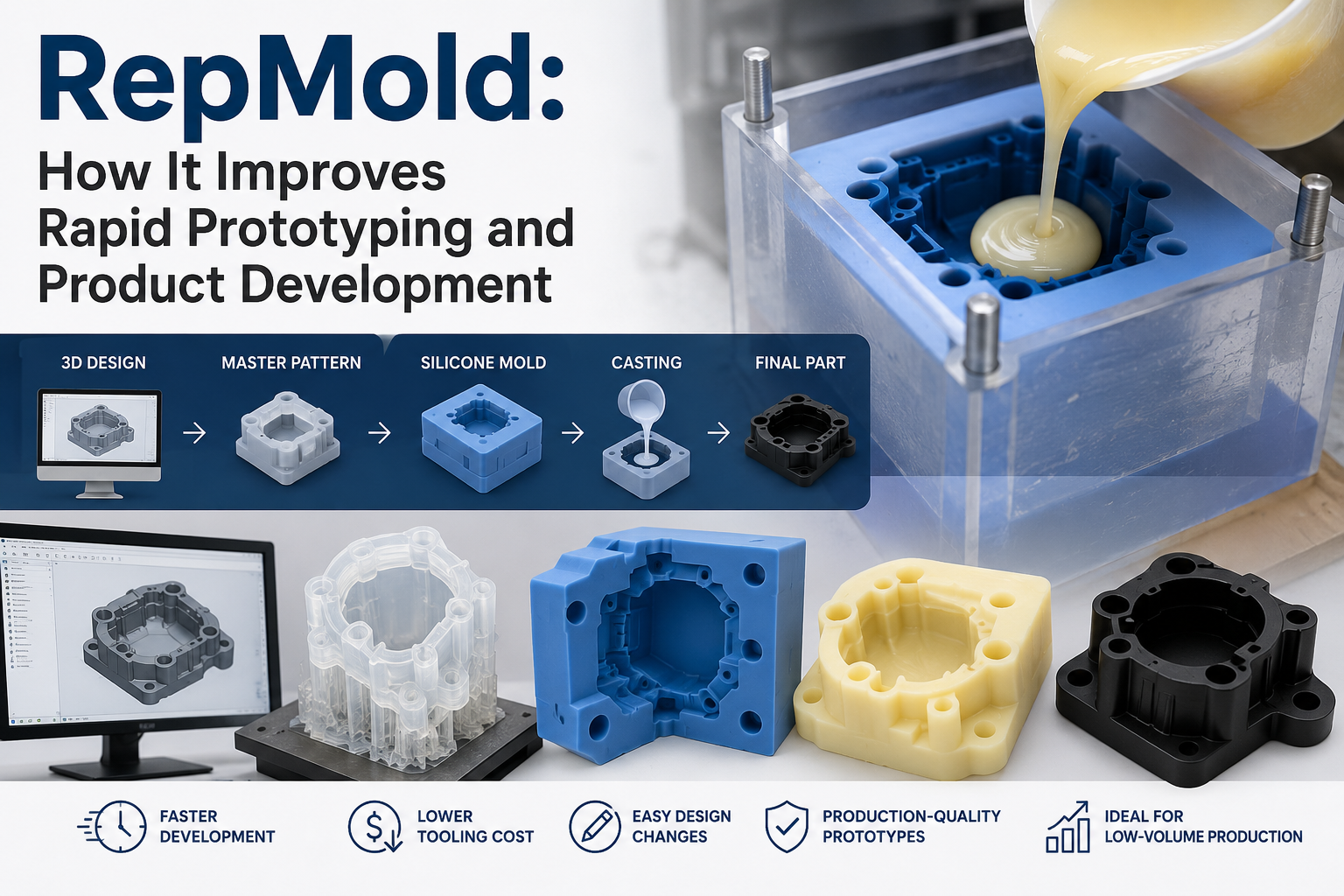
RepMold: How It Improves Rapid Prototyping and Product Development
RepMold is an emerging manufacturing workflow that combines digital design, rapid prototyping, silicone molding, and resin casting to create production-quality prototypes and low-volume parts with greater speed and efficiency. It serves as a practical bridge between early-stage product development and full-scale manufacturing, allowing engineers and designers to validate concepts, test functionality, and refine designs before investing in expensive metal tooling.
As manufacturers strive to shorten development cycles and reduce production costs, it has gained attention for its flexibility and cost-effectiveness. Integrating proven technologies such as CAD modeling, 3D printing, CNC machining, and reusable silicone molds enables faster product iterations while minimizing material waste and development risks. Although it is not an officially standardized manufacturing technology, it represents a modern approach to replication-based molding that supports innovation across industries such as automotive, medical devices, consumer electronics, aerospace, and industrial manufacturing.
What Is RepMold?
It is best understood as a manufacturing workflow that focuses on creating reusable molds from a high-quality master pattern. These molds are then used to produce multiple identical components through resin or polyurethane casting.
Unlike conventional injection molding, which requires expensive steel molds capable of producing millions of parts, RepMold emphasizes flexibility, affordability, and rapid product development. It is particularly valuable during product validation, engineering testing, bridge manufacturing, and small production runs.
Instead of viewing it as a standalone machine or software platform, it is more accurate to consider it a combination of established manufacturing technologies working together to simplify the product development process.
Its primary goals include:
- Reducing development time
- Lowering tooling costs
- Producing highly accurate prototypes
- Supporting rapid design improvements
- Enabling efficient low-volume manufacturing
Understanding the RepMold Manufacturing Workflow
RepMold follows a structured process that transforms a digital concept into a functional physical product.
Product Design
The workflow begins with a digital product concept. Engineers create detailed three-dimensional models using CAD software, defining dimensions, tolerances, material properties, and functional requirements.
Digital design allows manufacturers to evaluate products before physical production begins, reducing costly design mistakes.
Master Pattern Creation
Once the design is finalized, a master pattern is produced. This master serves as the template for creating reusable molds.
Common manufacturing methods include:
- SLA 3D printing
- PolyJet printing
- CNC machining
The master pattern must accurately reproduce every detail because the final mold captures its exact geometry.
RepMold Fabrication
The master pattern is placed inside a mold box where liquid silicone or urethane material is poured around it.
After curing, the master is removed, leaving behind a precise cavity that reproduces the original design.
This flexible mold becomes the foundation for producing multiple identical components.
Casting and Production
The mold cavity is filled with polyurethane, epoxy resin, or other casting materials.
Depending on production requirements, vacuum casting may be used to eliminate trapped air bubbles and improve surface quality.
Each casting cycle produces another accurate replica of the original design.
Inspection and Validation of RepMold
Finished parts undergo quality inspection before approval.
Manufacturers typically verify:
- Dimensional accuracy
- Surface finish
- Mechanical performance
- Functional compatibility
Only after successful validation is the design considered ready for larger-scale manufacturing.
Core Technologies Behind RepMold
RepMold combines several established manufacturing technologies into one efficient workflow.
Computer-Aided Design (CAD)
CAD software enables engineers to create precise digital models before manufacturing begins. It also allows rapid design revisions without rebuilding physical prototypes.
Computer-Aided Manufacturing (CAM)
CAM software converts digital models into manufacturing instructions for CNC machines and other production equipment.
CNC Machining
CNC machines produce highly accurate master patterns from aluminum, engineering plastics, or other materials when exceptional precision is required.
RepMold Additive Manufacturing
High-resolution 3D printing technologies, including SLA and PolyJet printing, provide fast and affordable master patterns for silicone mold production.
Silicone Mold Technology
Silicone molds offer excellent flexibility, allowing manufacturers to produce multiple replicas while maintaining fine details and smooth surface finishes.
Vacuum Casting
Vacuum casting removes trapped air during the casting process, improving dimensional accuracy and reducing surface defects.
Materials Used in RepMold
Material selection plays a significant role in determining product quality and performance.
Master Pattern Materials
Master patterns are commonly produced from:
- SLA resin
- ABS plastic
- Nylon
- Aluminum
- Engineering-grade plastics
RepMold Materials
Reusable molds are typically made from:
- Silicone rubber
- Urethane rubber
These materials provide flexibility while accurately reproducing fine details.
Casting Materials
Finished products may use:
- Polyurethane resin
- Epoxy resin
- Flexible elastomers
- Engineering plastics
Each material offers different characteristics, including strength, flexibility, heat resistance, and durability.
Key Benefits of RepMold
RepMold offers several advantages over traditional manufacturing approaches.
Faster Product Development
Because molds are created directly from digital designs, prototype production is significantly faster than conventional tooling methods.
This enables businesses to introduce products more quickly while reducing development delays.
Lower Tooling Costs
Steel injection molds require substantial investment.
RepMold minimizes upfront costs by replacing permanent tooling with reusable silicone molds suitable for prototype and low-volume production.
Greater Design Flexibility
Product development rarely follows a straight path.
It allows engineers to modify designs, print new master patterns, and create updated molds without rebuilding expensive tooling.
High-Quality Prototypes
Unlike simple demonstration models, RepMold can produce functional prototypes that closely resemble final production parts in appearance and performance.
Reduced Manufacturing Waste
Digital validation and efficient mold production reduce unnecessary material consumption during product development.
RepMold vs Traditional Injection Molding
While both it and traditional injection molding are used to manufacture molded parts, they are designed for different production needs. It is ideal for rapid prototyping and low-volume manufacturing, whereas traditional injection molding is better suited for high-volume mass production. The table below highlights their key differences.
| Feature | RepMold | Traditional Injection Molding |
| Production Volume | Low-volume & prototypes | High-volume mass production |
| Mold Type | Silicone/Urethane molds | Steel/Aluminum molds |
| Tooling Cost | Low | High |
| Lead Time | Short | Long |
| Design Changes | Easy & affordable | Costly & time-consuming |
| Best For | Prototyping, testing, bridge production | Large-scale manufacturing |
Industries That Benefit from RepMold
The flexibility of it makes it valuable across numerous industries.
Automotive
Manufacturers produce prototype interior panels, dashboard components, brackets, and testing models before committing to full production.
Medical Devices
Medical equipment manufacturers use RepMold to develop housings, diagnostic equipment components, and prototype surgical instruments requiring high precision.
Consumer Electronics
Companies rapidly prototype smartphone accessories, wearable devices, connectors, and electronic enclosures to accelerate product launches.
RepMold Aerospace
Engineers create lightweight prototype components for testing while minimizing development costs.
Consumer Products
Household products, sporting goods, personal care items, and packaging components often undergo multiple design iterations before mass production begins.
Quality Control in RepMold Manufacturing
Quality remains a critical part of every RepMold project.
Manufacturers typically inspect each casting for:
- Dimensional accuracy
- Surface defects
- Mechanical integrity
- Assembly compatibility
- Functional performance
Consistent quality control ensures that prototypes accurately represent future production parts.
Challenges and Limitations
Despite its many advantages, RepMold is not suitable for every manufacturing scenario.
Silicone molds gradually wear after repeated use, making them less practical for extremely high production volumes.
Certain engineering materials may require specialized casting techniques or may not be compatible with flexible molds.
In addition, successful implementation requires skilled engineers familiar with CAD modeling, prototype development, and quality inspection procedures.
For products requiring millions of identical components, traditional steel tooling generally remains the better long-term solution.
Sustainability and Future Trends
Sustainability has become an important consideration in modern manufacturing, and it supports this goal by reducing unnecessary waste during product development.
Instead of producing multiple expensive metal molds during early testing, manufacturers can validate designs digitally and create only the prototypes needed for evaluation.
Future developments are expected to make replication molding even more capable through the integration of artificial intelligence, automated inspection systems, digital twin technology, and advanced casting materials.
Machine learning may soon assist engineers by predicting manufacturing defects, optimizing mold geometry, and improving production efficiency before physical manufacturing even begins.
As smart manufacturing continues to expand, RepMold workflows are likely to become increasingly connected with digital factories and Industry 4.0 environments.
Conclusion
It represents a practical approach to modern product development by combining digital engineering, reusable silicone molds, rapid prototyping, and precision casting into a streamlined manufacturing workflow. Rather than replacing traditional injection molding, it complements existing production methods by providing a faster and more economical path from concept to functional prototype.
Its ability to reduce tooling costs, support rapid design iterations, and deliver production-quality components has made replication-based molding increasingly valuable across industries such as automotive, healthcare, aerospace, electronics, and consumer products. As digital manufacturing technologies continue to evolve, RepMold workflows are expected to become even more intelligent, efficient, and sustainable, helping businesses innovate faster while maintaining the quality standards demanded by today’s competitive markets.
FAQs About Repmold
How does it differ from injection molding?
Injection molding relies on permanent steel tooling for high-volume production, while it uses reusable silicone molds that are faster and more affordable for prototype development and smaller production runs.
Which industries commonly use RepMold?
Automotive, aerospace, medical devices, consumer electronics, industrial manufacturing, and consumer product companies frequently use replication-based molding during product development.
Can it produce production-quality parts?
Yes. When appropriate materials and quality control procedures are used, RepMold can create functional components suitable for engineering evaluation, customer demonstrations, and limited commercial production.
Is it suitable for startups?
Yes. Because it significantly reduces tooling costs and shortens development timelines, it is particularly attractive to startups developing new products with limited budgets.